Home › News › Chemical registration: a complete guide to the new regulations
Chemical registration: a complete guide to the new regulations
27.06.2025
14 min.
576
Since 2024, a new chemical safety system has been in force in Ukraine, requiring businesses to adapt to European standards. The pre-registration of chemical substances, the implementation of a Unique Formula Identifier (UFI) for hazardous mixtures, and updated labelling are no longer a future requirement, but an immediate necessity. This guide will help you understand the new rules, prepare in a timely manner, and avoid hefty fines.
What Do the New Technical Regulations Change?
The foundation of the new system is Law No. 2718-IX, adopted to implement key documents that harmonise Ukrainian legislation with the European REACH and CLP frameworks.
ТTechnical Regulation No. 847-2024: concerns the safety of chemical products and establishes the obligation for pre-registration and full registration of each chemical substance that is manufactured or imported in quantities above 1 tonne per year. The competent authority is the Ministry of Economy, Environment and Agriculture of Ukraine (Ministry of Economy).
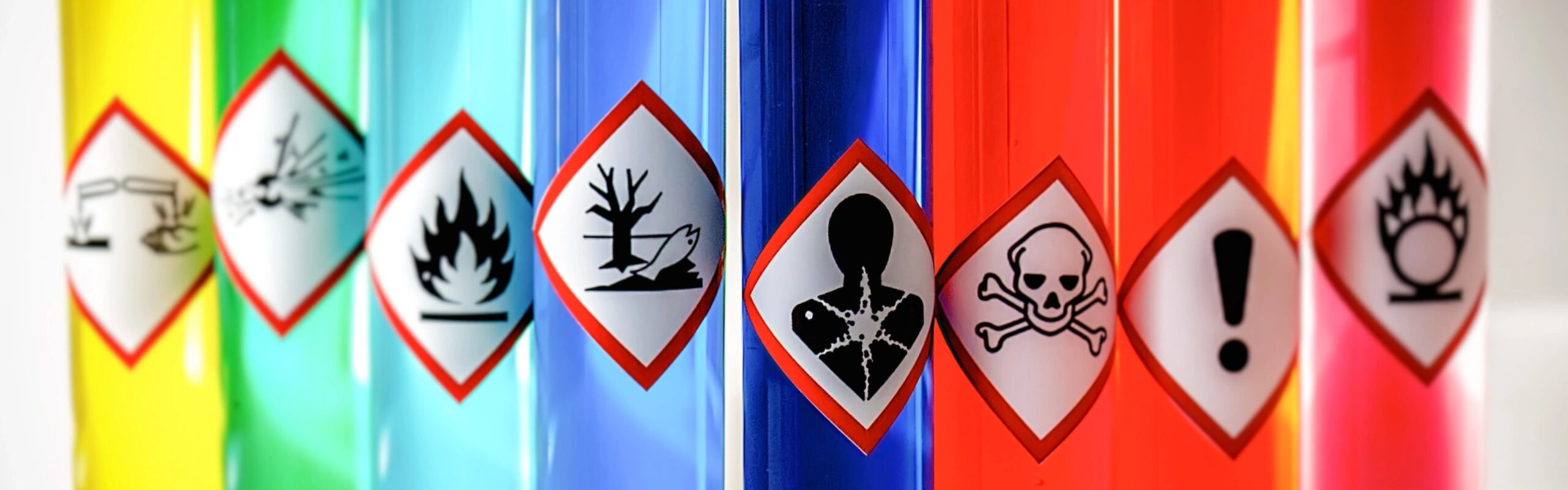
Technical Regulation No. 539-2024: regulates the classification, labelling, and packaging of chemical products. It introduces the concept of a Unique Formula Identifier (UFI) for hazardous mixtures and requires the submission of notifications to the Ministry of Health (MoH).
Substances and Mixtures: Key Differences in Registration
It is essential to recognise that distinct compliance procedures apply to individual substances and to mixtures.
Parameter
Chemical Substance
Chemical Mixture
Pre-registration (Ministry of Economyt)
✅Yes (mandatory)
❌ No
Full registration (Ministry of Economy)
✅ Yes (phased)
❌ No
Classification and labelling (TR 539)
✅ Yes
✅ Yes
UFI (for hazardous mixtures)
❌ No
✅ Yes
Notification (MoH)
❌ No
✅ Yes
Key Deadlines: How Not to Miss Critical Dates
Time for preparation is limited. Here are the key dates you should put in your calendar:
By 06.12.2026 (inclusive) — transition period to bring products into compliance with TR No. 539 (classification, labelling and packaging), except for the exemptions below
By 15.11.2027 (for substances) — postponed application of classification criteria in Sections 3.11.2.1–3.11.2.3, 4.2.2.1–4.2.2.3, 4.3.2.1–4.3.2.4, 4.4.2.1–4.4.2.4 of Annex I and the corresponding hazard communication elements 3.11.4.1, 4.2.4.1, 4.3.4.1, 4.4.4.1 of Annex I.
By 01.05.2028 (for mixtures) — postponed application of the same Annex I criteria (3.11.2.1–3.11.2.3, 4.2.2.1–4.2.2.3, 4.3.2.1–4.3.2.4, 4.4.2.1–4.4.2.4) and the same hazard communication elements (3.11.4.1, 4.2.4.1, 4.3.4.1, 4.4.4.1).
By 01.07.2028 — chemical products placed on the market before 01.01.2027 and still labelled/packaged under the “old” rules may not be prohibited or restricted solely due to non-compliance with TR No. 539 labelling/packaging requirements
After 06.12.2026: Within30 days after the first placing on the market — for each new hazardous substance, a classification notification must be submitted to the Ministry of Economy, Environment and Agriculture (paras. 125–129 of TR No. 539).
26.01.2025 – 26.01.2027 — the pre-registration submission “window” for chemical substances (UA-REACH). Substances without pre-registration cannot be legally placed/kept on the market. Products without pre-registration will not be permitted to remain on the market legally. After 26.01.2027, placing substances on the market is possible only after full registration.
2029 / 2031 / 2033 — deadlines for full registration of substances depending on annual tonnage and hazard profile, provided that pre-registration was submitted.
When Documents Must Be Submitted: Key Criteria
1) Classification Notification (UA-CLP)
Submission is mandatory if both of the following conditions are met simultaneously:
The substance is classified as hazardous;
and the annual volume placed on the market is ≥ 1 tonne per year.
What if the conditions are not met?
If the volume is < 1 tonne per year: no notification is required, but you must still prepare an internal classification, ensure proper labelling, and have a safety data sheet (SDS).
If the substance is not hazardous: no notification is required (even if the volume is > 1 tonne per year). In this case, an internal classification report and a label (without GHS symbols) are prepared.
2) Preliminary State Registration (UA-REACH)
Here, the only decisive factor is volume; the hazard classification does not matter.
Mandatory if: the annual volume of the substance (including in mixtures) is ≥ 1 tonne per year.
Not required if: the annual volume is < 1 tonne per year. In this case, it is sufficient to have internal classification, proper labelling, and an SDS.
Your Step-by-Step Compliance Plan
To adapt your business to the new requirements, act sequentially:
Inventory: Conduct a full audit of all chemical substances and mixtures that you manufacture or import. Determine their volumes and composition.
Classification and labelling: Determine the hazard classes for your products and update safety data sheets and labels in line with TR No. 539.
Appointment of a representative: If the manufacturer is a non-resident of Ukraine, an authorised representative responsible for compliance with the regulations must be appointed.
Pre-registration: Prepare and submit dossiers for the pre-registration of substances to the Ministry of Economy within the established timelines.
Preparation for UFI: For hazardous mixtures, generate a Unique Formula Identifier (UFI) and prepare the data required for notification.
Consequences of Inaction: From Fines to Customs Blocks
Ignoring the new rules may lead to serious financial and operational losses:
Fines: from UAH 17,000 to 340,000 for violations of chemical safety legislation (Article 244-8 of the Code of Administrative Offences).
Criminal liability: for the manufacture or sale of hazardous products that violate sanitary or environmental safety (Article 325-2 of the Criminal Code of Ukraine).
Customs issues: Blocking the import and export of products that do not comply with the regulations.
Market surveillance: Orders to withdraw products from the market and bans on their sale.
Do Not Risk Your Business: Get Professional Support
The adaptation process is complex and requires deep expertise. To ensure that you pass all stages correctly and on time, seek professional assistance.
Order an audit of your products, and we will help you:
We use cookies to ensure that we give you the best experience on our website. If you continue to use this site we will assume that you are happy with it.